Skip to content
Your roof does its job so quietly that it’s easy to forget it exists right up until it doesn’t. By the time you notice a water stain on your ceiling or a shingle in your yard, the damage underneath is almost always worse than what you can see from the ground.
The honest truth? Most roofs give off plenty of warning signs long before they fail. The problem is that most homeowners don’t know what to look for or they spot something and assume it can wait.
In this blog, we’re going to walk you through the 10 warning signs that your roof needs to be replaced including several that even experienced homeowners routinely overlook. We’ll also give you a quick roof inspection checklist you can use to assess your own roof safely from the ground and from the attic.
Essentials Home Solutions is a top local roofing contractor that has been inspecting and replacing roofs across Arlington, TX and the DFW Metroplex for over 10 years. Every sign on this list is something we see on real roofs in this area every single week.
First: How Long Should a Roof Last?
Before we get into the warning signs, it helps to know your roof’s expected lifespan. The most common roofing material in Texas, asphalt architectural shingles is rated for 25 to 30 years under ideal conditions. But “ideal” rarely describes a North Texas roof.
DFW roofs take a serious beating. Summer temperatures regularly push 100°F or higher, UV radiation degrades shingle granules year after year, and hailstorms which strike the DFW Metroplex more frequently than almost any other metro in the country cause impact damage that accumulates over time even when individual storms don’t look that severe.
| Roofing Material | Rated Lifespan | Realistic in Texas | Replace If Over |
| 3-Tab Asphalt | 15–20 years | 12–18 years | 15 years |
| Architectural (Laminate) | 25–30 years | 20–25 years | 20 years |
| Class 4 Impact Resistant | 30+ years | 25–30 years | 25 years |
| Metal (standing seam) | 40–70 years | 40–60 years | 45 years |
| Wood Shake | 20–25 years | 15–20 years | 18 years |
The takeaway: if your roof is within 5 years of its expected end of life and you’re seeing any of the signs below, replacement is almost certainly the smarter financial decision over repairs.
10 Warning Signs Your Roof Needs to Be Replaced
We’ve ordered these from most to least visible starting with signs you might spot during a casual walk around your house, and finishing with the subtle issues that only a trained eye or an attic inspection will catch.
1. Granule Loss in Your Gutters or Downspouts – Urgent If Widespread
Asphalt shingles are coated with mineral granules tiny, sand-like particles that protect the shingle mat from UV radiation and heat. When those granules start to shed, your shingles are telling you they’re aging out. You’ll notice them as dark, sandy grit collecting in your gutters, piling up at the base of your downspouts, or scattered on the ground where water drains off your roof. A few granules here and there is normal.
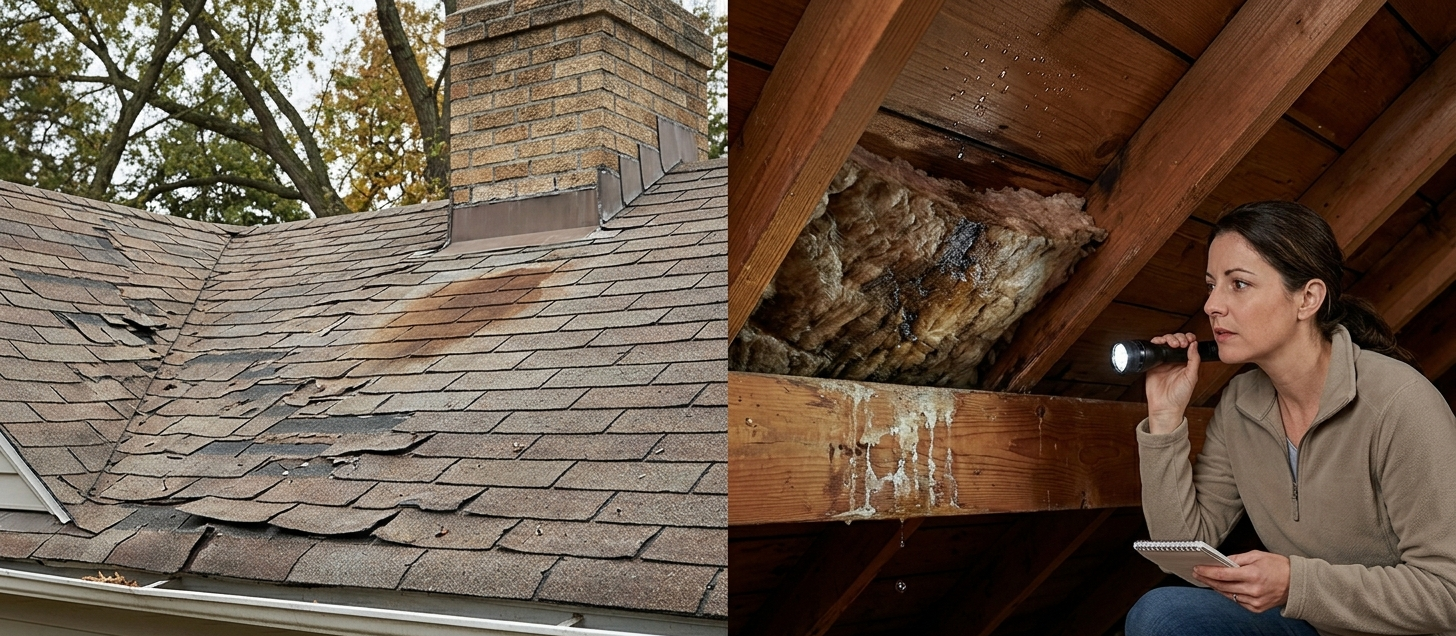
If you’re scooping out handfuls after a rain or finding large bald patches on the shingles themselves, that’s a serious warning sign. Granule loss dramatically accelerates shingle aging because the exposed asphalt underneath bakes in the sun, becomes brittle, and cracks leading to leaks. On DFW roofs, granule loss often coincides with hail damage even when the hailstorm seemed minor at the time.
2. Curling, Cupping, or Clawing Shingles – Serious
Healthy shingles lie flat and uniform against your roof deck. When they start to fail, they curl and there are two distinct patterns worth knowing. Cupping happens when the edges of the shingle turn upward, creating a concave bowl shape. This is usually caused by moisture imbalance between the top and bottom layers of the shingle and is a sign of age or poor attic ventilation.
Clawing happens when the middle of the shingle lifts while the edges stay flat a sign of an aging shingle mat that has lost its flexibility. Both types of curling create gaps where wind can get underneath the shingles and tear them off, and where water can infiltrate the decking underneath. Walk around your home and look up at your roof at a low angle curled shingles are easiest to spot in raking light (early morning or late afternoon). If more than 20% of your shingles show curling, the roof is near the end of its life.
3. Missing or Cracked Shingles – Repair Or Replace
A missing shingle isn’t just a cosmetic problem. Every gap in your roof surface is a direct path for water to reach the decking underneath. In DFW, where storm winds regularly exceed 60 mph and severe thunderstorms can arrive with little warning, shingles that have lost their seal strip or been weakened by age are particularly vulnerable.
Cracked shingles are equally concerning. Unlike the gradual curling caused by aging, cracking is usually the result of wind damage, thermal stress (extreme temperature swings between Texas summer highs and winter lows), or impact. A few cracked shingles can be repaired but if cracking is widespread across multiple areas of your roof, replacement makes more financial sense than patching.
One important note: if you only see damage in a concentrated area after a storm, that could be a wind or hail claim situation. Have a contractor document it before you do any repairs.
4. Damaged, Deteriorated, or Missing Flashing – Often Missed
Flashing is the thin metal (usually aluminum or galvanized steel) installed at every joint and penetration point on your roof around chimneys, skylights, pipe boots, dormer walls, and in the valleys where two roof planes meet. It’s the part of your roof that keeps water from sneaking in at the seams, and it’s the part that fails most often.
Flashing can pull away from the surfaces it’s sealing, rust through, or simply deteriorate from thermal expansion and contraction over years of Texas temperature extremes. When flashing fails, water doesn’t just drip in it channels in, often running several feet along the decking or rafters before it shows up as a stain on your ceiling.
That distance makes water intrusion from failed flashing notoriously hard to trace back to its source. Look for gaps, rust stains, or lifted metal around any roof penetration. If you see white mineral deposits (efflorescence) on brick near your chimney, that’s a strong indicator that water is getting past the chimney flashing.
5. Sagging Roof Deck or Soft Spots – Critical
A roof that sags either across a wide area or in localized dips is one of the most serious warning signs on this list. Sagging indicates structural compromise: the decking (the plywood or OSB sheets that the shingles are nailed to) has been weakened by moisture, rot, or in some cases, the weight of multiple shingle layers over time. You can often spot widespread sagging from the ground by looking at your roofline it should be arrow-straight along the ridge and at the eaves. Any visible dipping or curving is a red flag. Localized soft spots are harder to catch without getting on the roof (which we don’t recommend for most homeowners).
A qualified home improvement contractor walking the roof will immediately feel the difference between solid decking and decking that’s been compromised by water infiltration. Sagging decking isn’t just a roofing problem it can signal issues with the rafters or trusses underneath, which escalates the repair complexity and cost significantly.
6. Daylight Visible in Your Attic – Often Missed
This one requires an attic inspection, but it’s arguably the most definitive test you can do without hiring anyone. On a bright day, go into your attic and let your eyes adjust to the darkness. If you can see pinpoints or streaks of light coming through the roof boards, that means there are gaps and where light comes in, so does water, cold air, and pests.
While you’re up there, also look for these signs of moisture damage: dark staining on the underside of the decking, soft or spongy wood along the rafters, frost on the rafters during cold weather (a sign of warm air escaping from the living space and condensing on cold surfaces), and any visible mold or mildew growth.
Many homeowners never check their attic, which is exactly why water damage from a failing roof often goes unnoticed for months sometimes years before it shows up on their ceiling. Even if you don’t see daylight, discoloration on the decking boards tells you where water has been getting in.
7. Deteriorating Fascia and Soffit – Often Missed
Your fascia is the vertical trim board that runs along the lower edge of your roof, capping the ends of your rafters. Your soffit is the horizontal surface underneath the roof overhang the part you see when you stand at your exterior wall and look up. Both play important structural and ventilative roles, and both are early indicators of a roof that’s been leaking.
When water gets under deteriorating shingles at the eaves, the fascia takes the first hit. Look for peeling paint, soft or spongy wood, rot, or dark water staining along your fascia boards. Compromised soffit particularly soffit that has pulled away from the fascia or shows signs of water staining suggests that water is not only getting past your shingles but running back up under the eaves.
In Texas, this pattern is common on older homes with low-slope eaves that weren’t properly designed for the intense summer rainstorms the region sees. Replacing fascia and soffit alone without addressing the roof is the definition of treating the symptom rather than the cause.
8. Moss, Algae, or Lichen Growth – Moderate
Green or black streaking across your shingles isn’t just an eyesore it’s a biological indicator that your roof surface is retaining moisture. Algae (the dark streaking most common in humid conditions) doesn’t immediately damage shingles but signals a moisture environment that accelerates aging. Moss is more concerning: it roots into the shingle surface, physically lifting the edges and creating pathways for water infiltration underneath. Lichen which looks like crusty gray or green patches is the most destructive of the three.
Its root-like structures (called rhizines) actually bond to the shingle granules and pull them away when the lichen is removed, accelerating granule loss. On North Texas roofs, algae streaking is particularly common on north-facing slopes and in areas shaded by trees.
While algae can sometimes be treated with appropriate cleaning products, widespread moss or lichen growth on an aging roof typically means the shingles have already lost significant service life.
9. Higher Energy Bills Without an Obvious Cause – Easy To Miss
This one surprises most homeowners. A failing roof especially one with compromised underlayment, missing granules, or poor attic ventilation caused by deteriorating soffit affects your home’s thermal envelope. In summer, a roof that’s lost significant granule coverage absorbs more heat and transfers it into your attic.
Without proper ventilation moving that heat out, it radiates down into your living space and forces your HVAC system to work harder. If you’ve noticed your electricity bills climbing year over year without a clear explanation and you haven’t added appliances, changed your habits, or made changes to your HVAC system it’s worth having your roof and attic insulation inspected.
In Texas, where summer cooling costs are substantial, a compromised roof can add $30–$80 per month to your energy bill. That’s $360–$960 per year, which adds up fast against the cost of a replacement.
10. Recurring Leaks That Keep Coming Back – Replacement Likely
If you’ve had the same leak “fixed” more than once and it keeps returning often in the same area of your ceiling the problem isn’t the repair. It’s the roof. Persistent leaks almost always mean one of two things: either the damage is more widespread than the visible entry point, or the underlying cause (failed flashing, cracked decking, compromised underlayment) is something surface patching can’t address.
This is particularly common on roofs that have had multiple repair attempts over the years. Each patch changes the water flow slightly, which sometimes causes a new entry point to develop nearby.
If you’ve spent more than $1,500 on roof repairs in the past three years on a roof that’s over 15 years old, you’ve probably crossed the threshold where replacement is the more cost-effective long-term decision.
Your Roof Inspection Checklist: What to Look For (Safely)
You don’t need to get on your roof to assess its condition and for most homeowners, we’d actually prefer you didn’t. Here’s a safe, systematic inspection you can do yourself in under 30 minutes that will give you a clear picture of your roof’s health.
From the Ground (Exterior)
- Binoculars check: Walk around the entire perimeter of your home. Use binoculars or your phone’s camera zoom to get a closer look at any areas of concern.
- Ridge line: Stand back and look at the ridge (the peak of your roof). It should be perfectly straight. Any dipping, sagging, or waviness is a structural warning sign.
- Shingle surface: Look for missing shingles, visible bald spots (granule loss), and any shingles that appear to be lifting, curling, or sitting at an odd angle.
- Gutters and downspouts: Look inside your gutters — dark, sandy grit is granule runoff from aging shingles. Also check for shingle debris or pieces of shingle material.
- Fascia and soffit: Inspect the trim boards and underside of your eaves for peeling paint, discoloration, soft wood, or any areas that appear to be pulling away.
- Flashing points: Look at every chimney, vent pipe, dormer, and skylight on your roof. Any visible separation, rust, or lifted metal is worth a professional look.
- Moss or algae: Note any green or black streaking, particularly on north-facing or shaded sections of your roof.
From Inside (Attic Inspection)
- Daylight test: On a clear day, turn off the attic light and look for light coming through the roof boards. Any visible light means there are gaps.
- Water staining: Inspect the underside of the decking for dark stains, discoloration, or mineral deposits — these indicate historic water intrusion even if the roof isn’t actively leaking right now.
- Decking condition: Press gently on the decking boards with your hand. Solid decking feels firm. Soft, spongy, or crumbling areas indicate rot from chronic moisture exposure.
- Rafter inspection: Check your rafters for any staining, softness, or mold growth — particularly along the tops where they meet the decking.
- Ventilation check: Make sure your soffit vents and ridge vents (if present) are not blocked. Proper airflow through the attic is critical to shingle longevity in Texas heat.
- Insulation condition: Wet or compressed insulation is a sign that water has been getting in. Healthy attic insulation should be dry, fluffy, and evenly distributed.
| Pro Tip | Take photos of everything you find. If you call a contractor, photos help them prioritize what to look at during their inspection and they protect you by documenting pre-existing conditions before any work begins. |
Roof Repair vs. Full Replacement: How to Decide
Not every warning sign on this list automatically means you need a full replacement. Here’s a straightforward decision framework we use at Essentials Home Solutions when we inspect a roof:
| Repair is likely the right call if… | Replacement makes more sense if… |
| Roof is under 15 years oldDamage is isolated to one area (1–2 squares)Shingles are still in good condition overallSingle failed flashing componentRepair cost is under 25% of replacement cost | Roof is over 20 years oldDamage affects more than 30% of the surfaceDecking is soft, rotted, or saggingMultiple leaks or recurring leaks after repairsInsurance claim covers replacement cost |
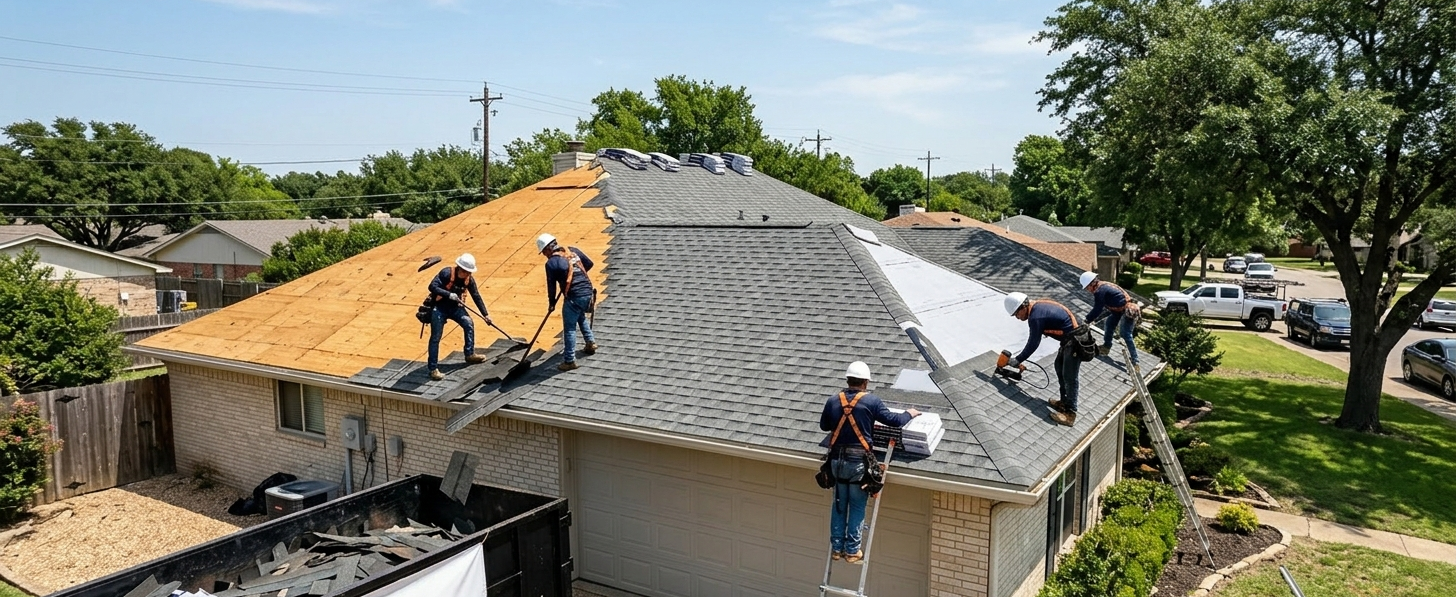
One rule of thumb that has served homeowners well for decades: if a repair costs more than 50% of what a full replacement cost, replace the roof. You’ll spend the same money but you’ll get 20–30 more years of service life and a full manufacturer’s warranty.
Frequently Asked Questions
How do I know if my roof is damaged after a hailstorm?
The best indicators after hail are: dark bruising or circular dents on shingles (look for a soft, spongey feel when pressed), dents on metal components like gutters, downspouts, flashing, and AC units, and granule loss concentrated in areas that took direct hits. After any significant hailstorm in the DFW area, it’s worth having a professional inspection many policies require claims to be filed within a year of the storm date, and hail damage that isn’t addressed continues to worsen with each subsequent storm.
Can I inspect my own roof safely?
We strongly recommend doing your assessment from the ground with binoculars, or from inside your attic. Getting on your roof without proper equipment and footwear is dangerous roofing surfaces are designed to shed water and can be slippery, and the angle of a typical residential roof makes a fall genuinely hazardous. Leave the physical inspection to a licensed contractor. Most reputable roofing companies, including Essentials Home Solutions, offer free inspections with no sales pressure attached.
What does granule loss actually look like?
In your gutters: a layer of dark, coarse, sand-like material — similar in texture to coarse sandpaper grit — that washes in after rain. On your shingles: lighter-colored bare patches against the darker granule-coated surface, usually most visible on the southern and western slopes that receive the most UV exposure. On your driveway or patio: small dark clusters where water drips off your roof edge.
My roof is only 12 years old — can it really need replacing already?
Yes, unfortunately. Age alone isn’t the deciding factor condition is. A 12-year-old roof that has been through multiple hailstorms, had poor installation, or was built with lower-grade materials can be functionally at end-of-life. Conversely, a well-installed, impact-resistant roof on a well-ventilated attic in a shaded location might still have significant life left at 20 years. The inspection checklist above will give you a much better picture than age alone.
What’s the difference between underlayment and decking?
Decking (also called roof sheathing) is the structural layer typically 7/16″ or 1/2″ OSB or plywood sheets nailed directly to your rafters or trusses. It’s what gives your roof its rigidity and provides the nailing base for everything above it. Underlayment is a water-resistant barrier (usually synthetic or felt paper) installed on top of the decking, beneath your shingles. It’s your secondary line of defense if water ever gets past the shingles.
When decking is damaged by water, it typically requires replacement at $70–$110 per sheet. This is one reason why addressing roof problems early matters so much a failing roof that’s left unattended eventually compromises the decking underneath, which turns a shingle replacement into a more extensive and expensive project.
Do I need a permit to replace my roof in Arlington, TX?
Yes. The City of Arlington requires a permit for full roof replacements (not minor repairs). Your licensed roofing installation and repair contractor should pull the permit on your behalf this is standard practice and is actually one of the ways you can verify a contractor is legitimate. If a contractor tells you a permit isn’t needed for a full replacement or asks you to pull it yourself, that’s a red flag. Permitted work is also inspected by the city, which gives you an additional layer of protection on a major investment.
Schedule Your Free Roof Inspection in Arlington, TX
If any of the 10 warning signs in this guide sounded familiar, the best thing you can do right now is get eyes on your roof before the problem gets worse. Every week a damaged roof goes uninspected is another week for water to quietly work its way into your decking, your rafters, and eventually your ceiling.
At Essentials Home Solutions, we offer expert roof inspections with same-day or next-day availability across the DFW Metroplex. First of all you must know the roofing inspection cost then you can decide, Our inspections include a full written assessment of your roof’s condition, photo documentation of any damage, and honest guidance on whether you need a repair or a full replacement with no pressure either way.
| Call or Text Anytime (817) 757-0022 Free Inspection · No Obligation · Same-Day Available | Essentials Home Solutions 3404 Timberwood Cir, Arlington, TX 76015 info@essentialshomesolutions.com BBB Accredited A+ · Yelp 5-Star Verified Serving Arlington · Grand Prairie · Mansfield · Irving · Fort Worth |