If your Texas windows are more than 15–20 years old, feel drafty, or your energy bills keep climbing, it’s time to consider replacement. Most homeowners in Texas save 10–25% on cooling costs after upgrading to energy-efficient windows, and a full window replacement typically pays for itself through comfort and energy savings within 8–12 years.
Here’s everything you need to know before you upgrade.
7 Signs You Need Window Replacement
Rising bills and physical damage are the clearest signals — here’s the full list.
- Rising energy bills — Your AC runs more but your home still feels warm, even after duct and insulation checks.
- Noticeable drafts — You feel air movement near the frame even when windows are closed and locked.
- Fog or condensation between panes — This means the seal has failed and the insulating gas has escaped; it can’t be fixed, only replaced.
- Windows are hard to open or close — Warped frames, painted-shut sashes, or broken balances point to structural failure.
- Frame rot or visible damage — Soft, discolored, or crumbling wood frames let in moisture and pests.
- Water leaks around the frame — Staining on the wall or sill below a window usually means the seal or flashing has failed.
- Too much outside noise — Old single-pane glass does little to block traffic, construction, or neighborhood noise.
Takeaway: If you’re seeing two or more of these signs, replacement is usually more cost-effective than repair.
Why Texas Is Different: SHGC Comes First
In Texas, prioritize SHGC (solar heat gain coefficient) over U-factor the opposite of what colder states recommend. Texas summers push cooling costs far higher than winter heating costs, so the priority is keeping solar heat out, not keeping indoor heat in.
- SHGC measures how much solar heat passes through the glass. Lower is better in Texas.
- The U-factor measures how well the window resists heat transfer overall. Still matters, but it’s secondary here.
This is why ENERGY STAR’s South-Central zone (which covers Dallas, Allen, Cedar Hill, Plano, and Fort Worth) sets stricter SHGC limits than northern zones.
Takeaway: A window rated well for Chicago isn’t automatically the right pick for Texas check the zone-specific rating.
What Specs to Look For
Look for an NFRC label showing SHGC of 0.23-0.25 and U-factor of 0.28-0.32 for most Texas homes. These are the ENERGY STAR South-Central recommended ranges.
| Spec | Recommended for TX | Why it matters |
| SHGC | 0.23 – 0.25 | Blocks solar heat, cuts AC load |
| U-factor | 0.28 – 0.32 | Limits heat transfer through the frame/glass |
| Glass type | Double-pane, Low-E coated | Reflects heat while letting in visible light |
| Gas fill | Argon | Improves insulation between panes |
| Pane count | Double-pane standard; triple-pane for west-facing or high-noise rooms | Extra performance where it’s needed most |
Every genuine ENERGY STAR window carries an NFRC label listing these exact numbers that don’t rely on a salesperson’s verbal claim, check the label yourself.
Takeaway: Ask for the NFRC sticker on the actual product, not a brochure average.
Window Installation Cost DFW and Across Texas
Expect to pay roughly $400-$1,100 per window installed in Texas, with a mid-grade vinyl double-hung window typically running around $650-$700.
Costs vary by material, size, and how many windows need custom framing versus a standard fit.
Vinyl vs. Fiberglass vs. Wood-Clad
| Material | Cost per window (installed) | Durability in TX heat | Maintenance |
| Vinyl | $400 – $800 | Good; can warp in extreme, prolonged heat if low-grade | Low |
| Fiberglass | $700 – $1,100 | Excellent; handles heat expansion/contraction well | Low |
| Wood-clad | $900 – $1,400+ | Good performance, but exterior cladding is essential in TX humidity/sun | Moderate to high |
A full-home project (15-20 windows) commonly lands between $8,000 and $18,000, depending on material and how much frame repair is needed.
Savings note: Homes upgrading from single-pane to ENERGY STAR double-pane windows typically see annual savings of roughly $125-$340, but savings from double-pane to a newer ENERGY STAR double-pane are much smaller. Actual savings depend on your home’s orientation, shading, and current AC efficiency treat any number as a range, not a guarantee.
What affects your final price:
- Window size and style (single-hung, double-hung, casement, bay/bow)
- Frame material (vinyl vs. fiberglass vs. wood-clad)
- Glass package (Low-E coatings, gas fill, number of panes)
- Full-frame replacement vs. pocket/insert replacement
- Number of windows and home accessibility
What to Expect: The Full Process
Expect four stages: in-home measurement, custom ordering, installation day, and a final inspection — typically spanning 2-6 weeks total.
- In-home measurement and consultation. A contractor measures each opening precisely, since Texas homes (especially older ones) often have slightly out-of-square frames.
- Custom manufacturing. Windows are built to those exact measurements; this is usually the longest wait, 2-5 weeks depending on material and supplier.
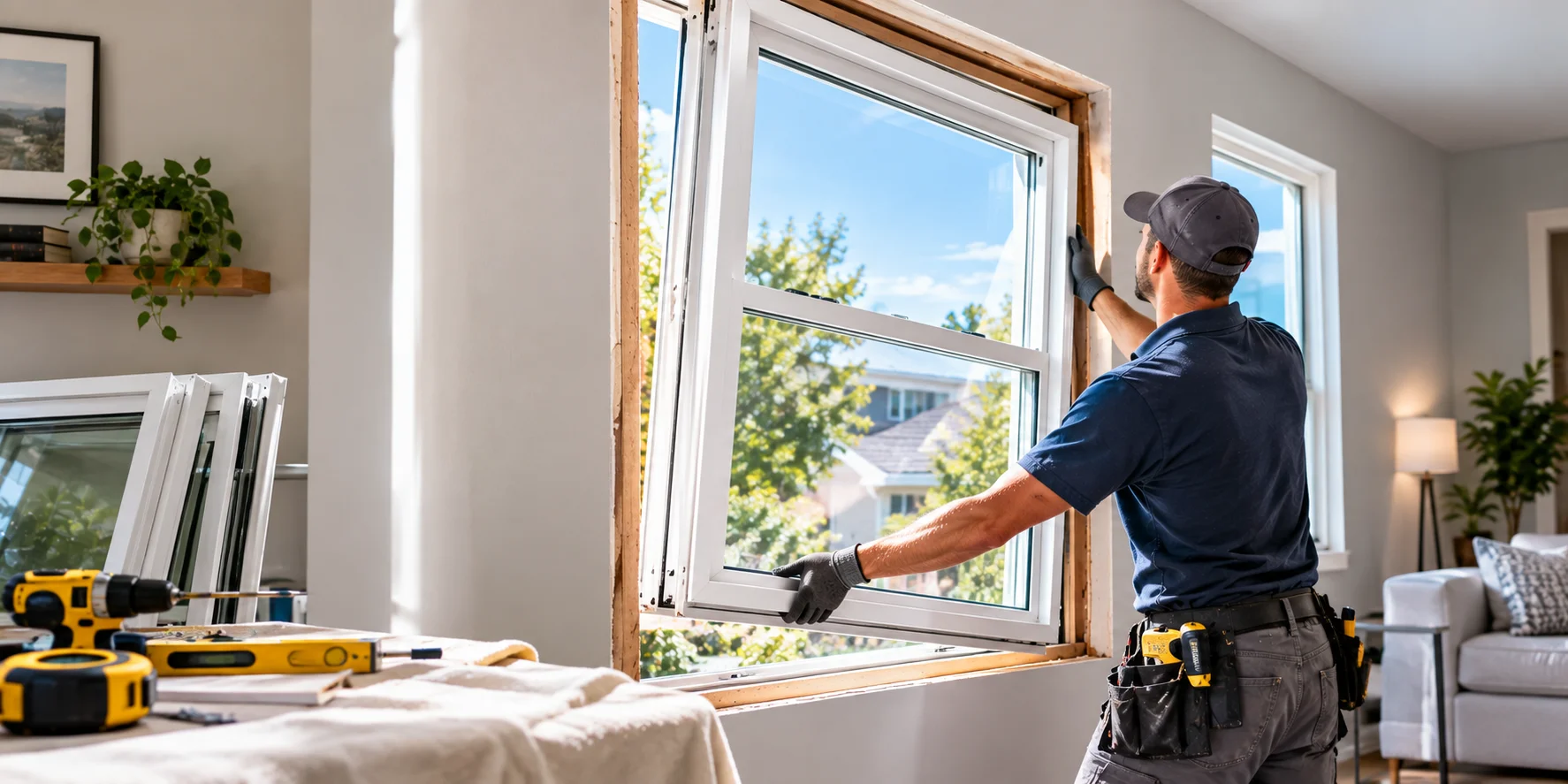
- Installation day. Old windows are removed, frames are checked for rot or damage, new units are set, insulated, and sealed. Most homes take one full day for a standard window count.
- Final inspection and walkthrough. The installer checks operation, seals, and caulking, and walks you through care and warranty paperwork.
Takeaway: A poor installation can undercut even the best window’s efficiency rating, which is why workmanship matters as much as product selection. For a closer look at what separates a quality installation from a problematic one, see our installation quality guide, Stop Bad Installs.
Best Time to Schedule (and How to Avoid Peak Pricing)
Schedule between December and February for the best pricing this off-season window typically saves 5-10% compared to summer booking.
Spring and early summer are peak demand seasons in Texas, since homeowners want new windows installed before the heat hits. Booking in winter also means shorter lead times, since manufacturers and crews are less backlogged.
Takeaway: If your windows aren’t in emergency condition, a winter booking is usually the better deal.
Is Window Replacement Worth It in Texas?
For most homeowners, yes — particularly if:
- Your windows are single-pane or older than 15 years
- You’re paying noticeably more for cooling than similarly sized homes nearby
- You’re planning to sell within the next few years (window replacement consistently ranks among the higher ROI home improvements)
- You want to reduce UV damage to interiors and improve comfort near windows
A Note on Texas Building Codes
Texas has no single statewide residential energy code, code adoption and enforcement vary by county and even by city, and often follow different versions of the IECC. This means window quality and installation standards can vary significantly between contractors, even within the same metro area. It’s worth asking any contractor directly which code edition they build to and whether they pull permits, rather than assuming a baseline standard applies everywhere.
Why Choose Essential Home Solutions Contractors?
A bad install can undo even the best window’s performance gaps, uneven caulking, and poor flashing lead to leaks and drafts no matter how good the glass is. If you’re comparing window contractors, ask for proof of manufacturer certification, a written warranty covering both the product and the labor, and references from recent local jobs. A contractor who won’t show you the NFRC label on the actual product, or who rushes the measurement visit, is a red flag.
Essential Home Solutions provides full window installation services across TX and the surrounding DFW area, including in-home measurement and a final inspection on every job so the install matches the spec on paper.
FAQs
How do I know if I need window repair or full replacement?
If the seal has failed (fogging between panes) or the frame is rotted/warped, replace it. Minor issues like a broken lock or torn screen are usually repairable.
What’s the average cost of window replacement in Texas?
Most homeowners pay $400-$1,100 per window installed, with full-home projects often totaling $8,000-$18,000 depending on material and window count.
Are triple-pane windows worth it in Texas?
Usually not necessary for standard rooms. They help most on west-facing walls or in high-noise areas, but double-pane Low-E windows meet most Texas homes’ needs.
Does Texas require ENERGY STAR windows by law?
No. Texas has no statewide energy code, so ENERGY STAR isn’t legally mandatory but it’s the standard most contractors and rebate programs use as a benchmark.
How long does a full window replacement project take?
Expect 2-6 weeks total: most of that is manufacturing lead time, while installation itself usually takes one day for a standard-size home.
Ready for an Upgrade?
If two or more of the signs above sound familiar, it’s worth getting a real number instead of guessing. Get a free window replacement quote from Essential Home Solutions and find out what upgrading actually costs for your home.